Stem cells vs PRP vs exosomes vs BMAC: what is actually in the syringe.
A clinic says “stem cells.” Another says “exosomes.” Another says “BMAC.” Here is what each of those is really made of, and what to ask before paying for any of it.
One clinic calls it stem cell therapy. The next clinic, in the next city, calls it exosome therapy. A third calls it BMAC. The brochures all sound like regeneration, restoration, and renewal. But these are not the same product. Some are blood components. Some are cell mixtures from your own body. Some are lab-grown cells. Some are donor tissue. Some contain no cells at all.1
Before you can decide whether something is right for you, it helps to know what it actually is. This page is a field guide to the seven product families clinics tend to put under one umbrella — platelet-rich plasma, bone marrow concentrate, fat-derived cell mixtures, lab-expanded mesenchymal stem cells, exosomes, donor birth tissue, and cord blood. For each, the question is the same: what is in the syringe, where did it come from, and what does that change about the conversation with the clinic?
Regenerative medicine is a real, active field. Some of the early biology is interesting. Some of the international approvals are real. But the field carries a vocabulary problem, and the vocabulary problem is where most of the confusion lives. So we start with identity, not verdict.
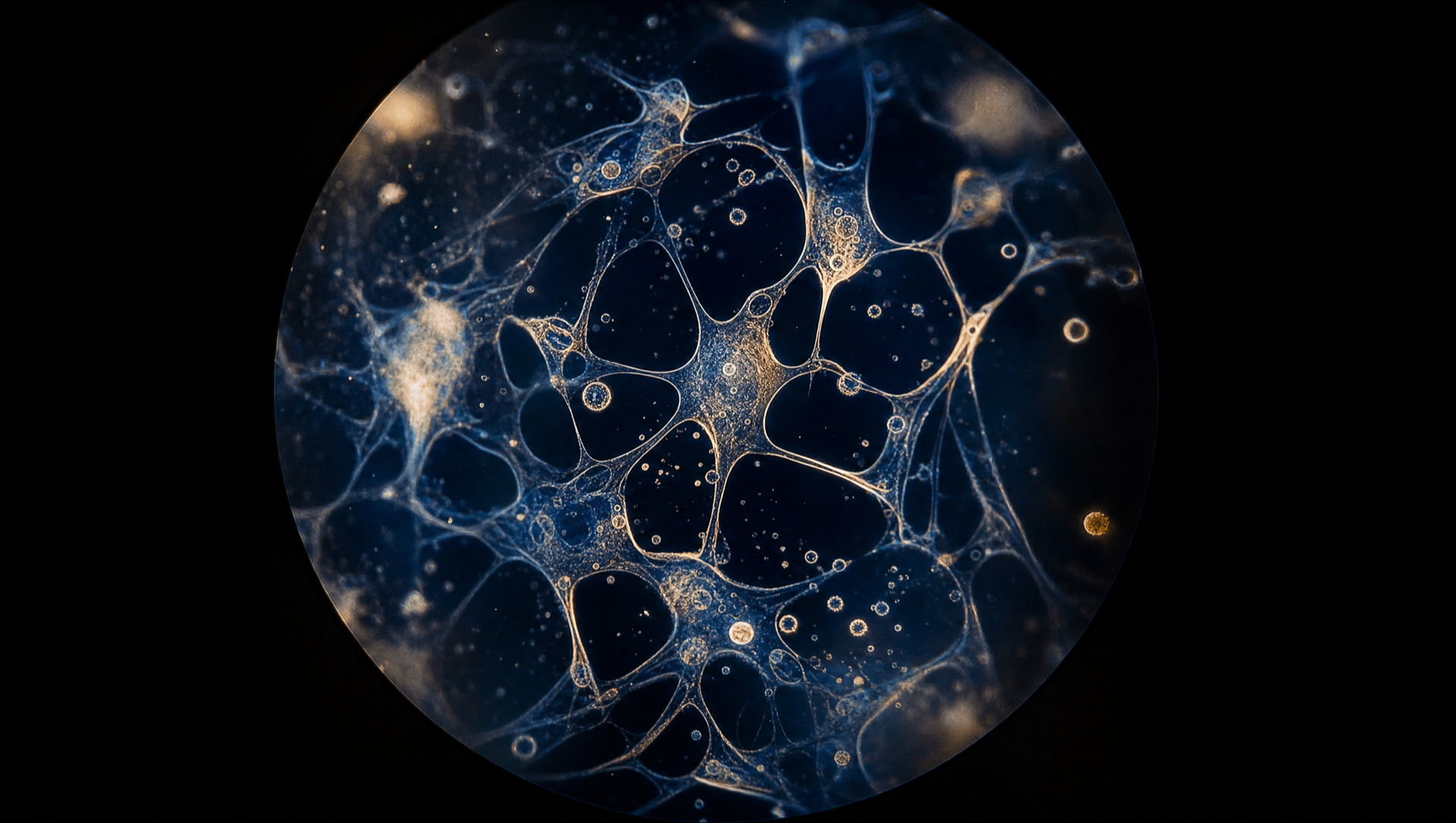
A microscope shows you what cells can do in a dish. It does not show you what is in a clinic’s vial.
Start with what it is, not what it does.
The single most useful habit when reading regenerative-medicine marketing is to insist on identity before evaluation. A study on one product does not automatically apply to another. A clinic’s marketing name often does not match the biological product. And two clinics describing “stem cell therapy” can be offering profoundly different things — with different regulators, different evidence, and different risks.
Three useful distinctions cut through most of the marketing fog:
Does it contain living cells? PRP and most injectable amniotic-fluid products do not. Exosomes are not cells at all. BMAC and SVF are cell mixtures from your own body. Cord blood and culture-expanded MSCs are real cell products.
Same-day or lab-expanded? A same-day concentrate is whatever your body produced this morning, run through a centrifuge. A lab-expanded product was grown over days or weeks in a culture facility, which is a different manufacturing question and a different regulator question.
From you, or from a donor? Autologous (your own tissue) and allogeneic (donor) products are not interchangeable. Autologous origin is not a safety guarantee. Donor origin is not a contamination concern by default. Both raise their own questions.
A simple product map.
Seven product families cover almost everything sold under the “stem cells / regenerative medicine” banner. The cards below are a quick reference — source, whether it contains living cells, how it is processed, whether it is yours or a donor’s, and the first question worth asking. Long explanations follow in the sections below.
Your own blood
PRP — platelet-rich plasma
Living cells?
No stem cells. Concentrated platelets and plasma.
Processing
Same-day, spun in the clinic.
From you or a donor?
From you.
First question to ask
What growth factors and platelet count am I actually being given?
PRP is your own blood, drawn into a tube and spun in a centrifuge until the platelets and a small volume of plasma are separated out. The resulting liquid contains concentrated platelets and the growth factors they carry. It contains no stem cells. The whole preparation usually takes well under an hour and happens in the clinic where you received the draw.3
What clinics usually claim
That PRP isa stem cell injection, or that it regenerates cartilage, hair follicles, or skin. Some marketing blends PRP and “stem cell” into a single phrase. That phrase contradicts itself.
What it may realistically be studied for
Pain and short-term function in some orthopedic uses, especially knee osteoarthritis and certain tendon conditions, and selected dermatologic uses such as hair shedding. The evidence is mixed, varies a lot by preparation, and is generally low- to moderate-certainty in systematic reviews.10 Studies measure pain and function, not tissue regrowth.
What to ask
Which preparation kit are you using? What platelet concentration does it produce? For my exact condition, what randomized trial supports this exact preparation? Is the benefit something I will feel, or only something visible on a scan?
Regulation, briefly
In the United States, FDA has cleared certain PRP preparation devices through the 510(k) pathway, but has not approved PRP itself for any indication.3 Device clearance and treatment approval are different things. Other jurisdictions regulate PRP differently — some treat preparation kits as medical devices, others as compounded blood products under hospital-pharmacy oversight.
Bone marrow aspirate concentrate
BMAC — a mixed concentrate from your own bone marrow.
BMAC is bone marrow drawn from the back of the pelvis under local anesthesia, then spun to concentrate the cell-rich fraction. The concentrate is a mixture: some mesenchymal stem cells, some blood-forming cells, platelets, plasma proteins, and other marrow components in proportions that vary patient to patient. BMAC is not a purified stem cell product, and a same-day concentrate is biologically very different from cells grown in a lab over weeks.7
What clinics usually claim
That BMAC is MSC therapy, implying a clean, potent cell product. The actual MSC fraction is small, and it varies from patient to patient based on age, marrow quality, and the specific draw.
What it may realistically be studied for
Joint pain and function in knee osteoarthritis and some cartilage and tendon repair contexts. Randomized trials comparing BMAC to placebo or hyaluronic-acid injection have generally shown modest changes in pain scores, with substantial heterogeneity between studies.13
What to ask
How is this BMAC different from a lab-expanded MSC product? How many cells are typically in your concentrate, and what proportion are MSCs? What patient-felt outcome — not what imaging change — has been shown to improve in a randomized trial?
Regulation, briefly
Same-day autologous BMAC that meets the U.S. FDA’s “minimal manipulation” and “homologous use” criteria can be performed without a separate biologics license, but that is a regulatory category, not approval for any specific condition. The FDA has not approved BMAC as a treatment for knee osteoarthritis, disc disease, or the other indications it is widely marketed for.7
Adipose, SVF, microfragmented fat
Fat-derived products — processing matters more than marketing suggests.
Several different products go by “fat-derived stem cells.” Stromal vascular fraction (SVF) is the cell-rich layer isolated from your own fat by enzymatic digestion. Microfragmented fat is mechanically processed fat tissue, kept more intact. Both come from your own subcutaneous fat. They are not the same product, and regulators do not treat them the same way.6
What clinics usually claim
That “it is your own cells, so it is safe,” and that a single fat-derived injection or IV can treat arthritis, autoimmune disease, neurological conditions, and aging at the same time. The safety claim and the indication list both outrun the evidence by a wide margin.
What it may realistically be studied for
Local joint or soft-tissue uses where the product is delivered to the same kind of tissue it came from. Systemic claims — IVs for memory, energy, immune “reset” — are not supported by trial-grade evidence, and case reports of serious harm exist when fat-derived cells are injected far from their tissue of origin.12
What to ask
Is this enzymatic SVF, microfragmented fat, or something else? Is the product being delivered to the same kind of tissue it came from? What randomized trial supports this exact procedure for my exact condition?
Regulation, briefly
In the United States, FDA has treated enzymatically processed SVF as a biologic that requires a license — particularly when it is used to treat something the source tissue does not naturally do (“non-homologous use”).6 Other countries regulate fat-derived products through different pathways, and what is permitted in one jurisdiction is not automatically permitted in another.
Culture-expanded MSCs
Lab-expanded mesenchymal stem cells — a different manufacturing world.
Mesenchymal stem cells (MSCs) found in bone marrow, fat, the umbilical cord, and other tissues can be isolated and grown in a lab over days or weeks to produce a much larger number of cells than a same-day draw would yield. The starting tissue can be yours (autologous) or a donor’s (allogeneic), and the lab expansion is the part that changes the regulatory and quality-control questions most.8
What clinics usually claim
That “millions of expanded stem cells per dose” translate directly into clinical effect. Cell counts and biological effect are not the same thing. The relevant question is whether this cell product, prepared this way, has been tested in your condition.
What it may realistically be studied for
Specific cell-product / specific-condition pairings have real, ongoing controlled research — graft-versus-host disease, certain autoimmune conditions, some orthopedic uses. A few culture-expanded MSC products are conditionally authorized for narrowly defined uses in some non-U.S. jurisdictions. Generalizing those approvals to other indications, or to a different clinic’s in-house preparation, is not warranted by the data behind them.4
What to ask
What tissue did the cells come from? Are they yours or a donor’s? Where are they cultured and under whose oversight? Are you offering this inside a registered trial, under a hospital-exemption pathway, or as a cash-pay service? What published evidence supports this exact product, in this exact condition?
Regulation, briefly
Lab expansion almost always pushes a product into a more heavily regulated category. In the United States, that means biologic licensing under FDA. In several other jurisdictions, there are pathways for conditional or hospital-exemption use of specific culture-expanded products — but those pathways are tied to the exact product, exact indication, and exact facility, and do not generalize.
Exosomes
Exosomes — signaling vesicles, not cells.
Exosomes are very small lipid-bound vesicles, roughly 30 to 150 nanometers across, that cells release as a way of carrying proteins and other signaling molecules to other cells. Manufacturers isolate them from cultured cells — often mesenchymal stem cells — and sell them as injectable or topical products. They are not cells, not stem cells, and not “stem cells without the cells.”11
What clinics usually claim
That exosomes are the “next generation” of stem cell therapy, that they cross tissue barriers more easily than cells, and that they treat anything from cognitive decline to hair loss to chronic illness. The biology behind cell-to-cell signaling is genuinely interesting. The marketing is far ahead of the clinical evidence.
What it may realistically be studied for
Early-phase clinical research is active in several areas. No exosome product is FDA-approved for any indication today, and the agency has issued specific safety communications about unapproved exosome marketing.2
What to ask
What cells did these exosomes come from? How were they purified, and what is the quality-control program for each batch? Is the product made under cGMP-level manufacturing? What evidence specifically supports this product for my condition?
Regulation, briefly
U.S. FDA has been explicit that no exosome product is approved for any indication. Other jurisdictions vary, but the same two questions still apply: what is the exact product, and is it being delivered inside the kind of oversight (registered trial, hospital protocol, licensed indication) the data would justify?
Amniotic, Wharton’s jelly, cord tissue
Donor birth-tissue products — the “young cells” line, in plain English.
These products come from tissue donated after a delivery: amniotic fluid, amniotic membrane, the gelatinous Wharton’s jelly inside the umbilical cord, and the cord tissue itself. They are processed by manufacturers into injectables, topical preparations, or membrane sheets. What is actually inthe finished product depends entirely on how it was processed. Some preparations retain matrix proteins and signaling factors but few or no viable cells. Some keep a cell fraction. “Millions of young stem cells” marketing language has, in independent analyses of commercial samples, sometimes met very few cells in the vial.5
What clinics usually claim
That the cells are “young” or “newborn-source” and therefore more potent. That a single injection can regenerate joint cartilage, reverse aging, or restore systemic function. The biology of perinatal tissue is real and worth studying. The leap from that biology to a cash-pay injection for an unrelated condition is the part the marketing makes faster than the evidence allows.
What it may realistically be studied for
Amniotic-membrane allografts are well-established in wound care and some ophthalmologic uses. Cord-tissue MSCs are in early-phase research for a range of conditions. Most injectable uses sold direct to consumers — joint, anti-aging, IV, fertility — are unsupported by trial-grade evidence for those uses.
What to ask
What exactly is in this product at the moment of injection? Are there viable cells, and how is that verified per batch? Where was the tissue processed, by whom, and under what regulator or accreditation? Is this product approved or permitted for my exact condition, or being used outside its authorized scope?
Regulation, briefly
In the United States, some membrane allografts can qualify under FDA’s section-361 framework for minimally manipulated, homologous-use human tissue products. Injectable preparations marketed for orthopedic or systemic regenerative claims typically do not qualify there and would require biologic licensing they do not have.5 FDA has issued warning letters to manufacturers and clinics marketing donor birth-tissue products beyond authorized uses.9 Other jurisdictions regulate donor birth tissue under their own tissue-bank and biologic frameworks.
Cord blood
Cord blood — a real approved stem cell category, used for blood and immune disorders.
Cord blood collected at delivery contains hematopoietic progenitor cells — the blood-forming stem cells that rebuild the bone marrow after a transplant. Several manufactured cord-blood HPC products are FDA-approved as biologics for use in transplantation in people with certain blood and immune disorders. This is the textbook FDA-approved stem cell category.1
What clinics usually claim
Where it is offered for its approved use, the description tends to be careful. Where cord blood gets re-marketed for orthopedic injections, anti-aging IVs, or cosmetic indications, the language gets vague — because the approval does not cover those uses.
What the evidence supports
Hematopoietic stem cell transplantation using cord-blood HPCs is decades-deep standard care for specific blood and immune disorders, performed under defined protocols at academic transplant centers. Outside those indications, the case for cord blood is the same as the case for any other early-stage cell product: read the evidence carefully and ask what is specifically supported.
What to ask
Is the cord-blood product being offered for one of its approved indications? Is this a transplant pathway at a recognized center, or a clinic-level injection? If it is being marketed for a condition that is not in the approved label, where is the trial evidence — for that condition, that product, that route of delivery?
Regulation, briefly
Multiple cord-blood HPC products are FDA-licensed in the United States for specific blood and immune disorders. Cord-blood-derived MSC injections, when offered outside that approval, are a different product story — closer to the culture-expanded MSC and donor-tissue questions above.
Same word, different product.
“Stem cell therapy” is doing a lot of work in marketing copy that the underlying biology does not actually support. A few specific conflations show up over and over, and they are worth naming directly:
PRP is not stem cells.It is a blood product. When a clinic sells “stem cell PRP,” one of those two words is doing the wrong job.
Exosomes are not cells. They are vesicles cells release. Some of the science is interesting. None of the commercial products in the United States are FDA-approved.
BMAC is not a purified stem cell product. It is a same-day mixed concentrate from your own bone marrow. The MSC fraction is small and variable.
Donor birth-tissue injectables are not all alive. What is actually in the vial depends on processing, and several independent analyses have found very few or no viable cells in products marketed as containing “millions of young stem cells.”
One study cannot validate an entire category. A trial of one specific product, in one specific condition, with one specific route of delivery, is evidence for that exact thing. It is not evidence for everything a clinic decides to label with the same general word.
What changes when you travel abroad.
Different countries permit different products through different pathways. Some have hospital-exemption rules that allow named products to be used inside specific institutions. Some have conditional approval pathways for cell therapies that the FDA has not approved. Some have national tissue-bank or blood-product frameworks that look more or less like the U.S. ones. Some have lighter oversight, especially for cash-pay services. None of these differences is a verdict on the biology. They are differences in how that biology is allowed to be sold.
For a patient comparing a domestic clinic to an overseas one, the same identity questions still apply — and a few extra ones too:
What exactly is the product, by name and manufacturer?
What exactly is my condition, in the language a clinician would write in a chart?
What local oversight covers this clinic and this product — a regulator, a hospital, an ethics board, a registered trial?
Is the product approved, conditionally permitted, used under hospital exemption, offered inside a trial, or simply cash-pay?
Is the clinic using the same product, prepared the same way, for the same indication, as whatever evidence or authorization is being cited?
Approval abroad can be meaningful. It does not travel further than the product, the indication, the route, and the setting it was granted for.
Does it contain living cells, and how is that verified?
Is it processed same-day, or expanded in a lab over time?
What regulator, hospital, ethics board, or trial pathway oversees it where it is offered?
What study supports this exact product for my exact condition?
What outcome is being measured — pain, function, imaging, fertility, immune markers, or something else?
What happens, and what does it cost, if it does not work?
Quick answers to the questions readers usually arrive with.
Five common comparisons, in two or three sentences each. The longer answers live in the sections above.
Is PRP the same as stem cell therapy?
No. PRP is a portion of your own blood, spun in a centrifuge to concentrate platelets and the growth factors they release. It contains no stem cells. Some clinics market “stem cell PRP” — one of those two words is doing the wrong job.
Is BMAC the same as MSC therapy?
Not the same. BMAC is a same-day mixed concentrate from your own bone marrow that contains a small and variable fraction of mesenchymal stem cells alongside platelets, blood-forming cells, and plasma proteins. A culture-expanded MSC product is cells grown in a lab over days or weeks — a different manufacturing question and a different regulator question.
Are exosomes stem cells?
No. Exosomes are very small lipid-bound vesicles, roughly 30 to 150 nanometers across, that cells release to carry signals to other cells. They are not cells, not stem cells, and not “stem cells without the cells.” The U.S. FDA has stated explicitly that no exosome product is FDA-approved for any indication.
What is the difference between SVF and lab-expanded MSCs?
SVF (stromal vascular fraction) is a same-day cell-rich layer isolated from your own fat by enzymatic processing — a mixed population that includes some stem-like cells. Lab-expanded MSCs are cells purified from a starting tissue and then grown over days or weeks in a culture facility to produce a larger and more uniform cell count. Regulators almost always treat the two as different categories.
Are cord blood stem cells used for knees or anti-aging?
Approved cord blood products are FDA-licensed for specific blood and immune disorders, usually as part of a hematopoietic stem cell transplant performed at a recognized transplant center. They are not approved for knee injections, anti-aging IVs, or cosmetic uses. When a clinic markets “cord blood stem cells” for one of those uses, that is outside the approved indication.
Where to go from here.
If you want to keep reading, these pages go deeper on the method, the sources, and the practical questions to bring to a clinic conversation.
Not medical advice. Nothing here is tailored to your case. This page is to help you read product identity and ask sharper questions, not to prescribe.
Not a clinic recommendation. We do not name clinics as places to go or to avoid.
Not anti-treatment. Some patients, after reading carefully, will reasonably decide a specific product in a specific setting is worth trying. Some will not. Both are honest conclusions.
Not a verdict on the field. Regenerative medicine is moving. What is unsupported today may become supported in three years. What is approved today is still approved only for what it is approved for.
U.S. Food & Drug Administration. “Public Safety Notification on Exosome Products.” fda.gov · explicit statement that no exosome product is FDA-approved, with documented adverse-event investigations following unapproved exosome injections. Verified 2026-05-14. ↩
International Society for Stem Cell Research. “ISSCR Guidelines for Stem Cell Research and Clinical Translation.” isscr.org · the Clinical Translation chapter addresses non-homologous use, the difference between trial participation and routine care, and the limits of autologous-origin reasoning. Verified 2026-05-14. ↩
U.S. Food & Drug Administration. “Statement on Stem Cell Clinic Permanent Injunction” and related court rulings classifying enzymatically processed adipose-derived stromal vascular fraction as a 351 biologic. fda.gov. Verified 2026-05-14. ↩
U.S. Food & Drug Administration. “Same Surgical Procedure Exception under 21 CFR 1271.15(b)” and HCT/P framework guidance documents describing the regulatory category for same-day autologous bone marrow concentrate. fda.gov. Verified 2026-05-14. ↩
National Institutes of Health. “Stem Cell Information — Stem Cell Basics.” stemcells.nih.gov · NIH explainer of the hematopoietic, mesenchymal, embryonic and induced-pluripotent stem-cell taxonomy and what lab expansion does to a cell product. Verified 2026-05-14. ↩
International Society for Extracellular Vesicles and ISSCR. “Position Statement on Clinical Use of Extracellular Vesicles,” isev.org / isscr.org · community guidelines on exosome-based commercial products, with emphasis on characterization, manufacturing and oversight. Verified 2026-05-14. ↩
Kuriyan AE, Albini TA, Townsend JH, et al. “Vision Loss after Intravitreal Injection of Autologous ‘Stem Cells’ for AMD.”New England Journal of Medicine 2017; 376:1047–1053 · documented case series of severe vision loss after autologous adipose-derived cells were injected far from their tissue of origin. Verified 2026-05-14. ↩